**<h1>What Happens Inside Python When You Use Multi-threading vs multi-processing?</h1>**
**<h2>Introduction</h2>**
Python supports numerous operations, but does not enforce uniformity on their operation. The difference lies within the interpreter itself. Threads operate within one process, whereas each process creates its own execution environment. Memory allocation, CPU access, data transfer, and the Global Interpreter Lock all contribute to the end result. A Python Language Course in Delhi could be beneficial in understanding the internal mechanisms of the programming language instead of only learning that threads do I/O and processes do CPU stuff.
<h3>What occurs internally in one process?</h3>
A regular CPython program contains a process, an interpreter, a memory block, and at least one thread. In a standard version with GIL support, the Global Interpreter Lock (GIL) restricts only one thread to execute Python bytecode at once. Thread switching doesn’t mean that two instructions of Python code are executed simultaneously.
A thread is another execution pathway within the same process. Shared memory provides easier interaction, but also introduces race conditions.
<h3>What really happens with threading?</h3>
While creating a new thread in a program, the OS will manage another thread as well, but all threads will be in the same process. Each thread maintains its own execution state, whereas memory of the process is shared by all threads.
The process is straightforward. Workers share process memory, contend for the access to the interpreter, and may release the GIL while performing I/O operations. Main thread can use join(). A [Python Online Course](https://www.cromacampus.com/courses/online-python-training-in-india/) should explain this flow because more threads do not automatically make CPU-heavy code faster.
<h3>The hidden cost of shared memory</h3>
Shared memory is useful, but locks may be needed when threads change the same object. A lock protects a critical section, but another thread may wait.
<h3>What changes with multiprocessing?</h3>
Multiprocessing changes the memory model. A worker process has its own Python interpreter and memory space. Its GIL is separate from the GIL in another process.
The parent creates workers, each worker starts its own interpreter state, work crosses the process boundary, and results return to the parent. The major cost is data movement. Objects cannot normally be shared like ordinary thread data. Queues, pipes, or shared-memory tools are used for communication.
<h3>Threads vs processes</h3>
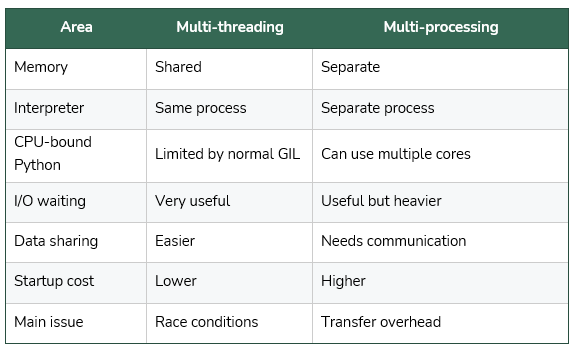
<h3>The GIL is not the full story</h3>
The GIL mainly limits simultaneous Python-bytecode execution in normal CPython. I/O and some native libraries can release it.
Since Python 3.13, CPython has supported optional free-threaded builds where the GIL can be disabled. They can allow threads to execute Python code in parallel, but they are not the default and extension support still matters. For a [Python with AI Course](https://www.cromacampus.com/courses/python-with-ai-course/), this matters because AI programs use native libraries.
<h3>The process boundary changes everything</h3>
Threads can access shared objects directly. Processes usually move data through serialization, queues, pipes, or shared memory. Large repeated transfers can erase CPU gains.
A good process design sends useful chunks instead of tiny messages. This is where python training in vizag can teach serialization and queue delays.
<h3>How should performance be measured?</h3>
Measure Python execution time, I/O waiting, worker startup, and data transfer. For CPU-heavy work, compare one process with a process pool. For I/O-heavy work, compare a thread pool. Use time.perf_counter() and repeat tests.
A Python Online Course is more useful when learners inspect timings and find the real bottleneck.
<h3>Python concurrency is changing</h3>
“Python threads cannot run in parallel” is now too broad. Standard GIL-enabled CPython limits Python bytecode to one thread, while free-threaded builds change that. Race conditions and library support still matter.
For learners doing python training in vizag, studying both models gives a better view of Python performance in 2026.
A [Python Language Course in Delhi](https://www.cromacampus.com/courses/python-training-in-delhi/) can teach learners to check the Python build before making thread-performance claims.
**Key takeaways**
● Threads share memory; processes use separate memory.
● The normal GIL limits Python-bytecode parallelism.
● I/O can make threads useful.
● Processes can use multiple CPU cores.
● Data transfer can reduce multiprocessing gains.
● Free-threaded CPython changes the old rule.
<h3>Frequently Asked Queries</h3>
**1. Does each thread have its own interpreter?**
No, threads share the same process and interpreter.
**2. Why is it possible for processes to run on different CPU cores?**
Because their interpreter states are independent of each other.
**3. Do threads make no sense for working with CPUs?**
No, because they can come handy when libraries unlock the GIL.
****4. Will multiprocessing always work faster?****
No, because startup and data transfer costs may be too high.
**5. Will the GIL lose its relevance in 2026?**
No, standard CPython will have it, while free-threaded will be another approach.
<h2>Sum Up</h2>
Threads stay inside one process and share memory, while processes use separate interpreter environments and memory spaces. The normal GIL makes this difference important for CPU-heavy Python code, but I/O, native libraries, and free-threaded CPython can change the result. Good development means measuring the workload, checking worker costs, and watching how much data moves between workers. Once learners understand these internal steps, choosing threads or processes becomes a technical decision based on the real program, hardware, workload, libraries, and data movement costs in real programs today.